Public Opinion Polling in Mid-Century British Literature: The Psychographic Turn (Oxford University Press, 2021)

Whereas modernist writers lauded the consecrated realm of subjective interiority, mid-century writers were engrossed by the materialization of the collective mind. The mid-century fascination with group thinking was fueled by the consecration of sociology within academia and the ubiquitous infiltration of public opinion research into a bevy of cultural and governmental institutions. As authors witnessed the materialization of the once-opaque realm of public consciousness for the first time, their writings imagined the potentiality of such technologies on the body politic. Polling opened a new horizon for mass politics. Olaf Stapledon’s poll-obsession, for instance, inspired a fictional utopia where a species might psychically tune into the cacophonous collective mind and, thus, construct a de-centralized utopian democracy. Elizabeth Bowen, performing her own public opinion work, found in wartime fiction a space to outline the importance of materiality as a metaphor for consciousness. Public Opinion Polling in Mid-Century British Literature: The Psychographic Turn traces the most crucial period of group psychology’s evolution — the mid-century — when a term originating in Victorian spiritualism transformed into a scientific praxis. The imbrication of British writers within a growing institutionalized public opinion infrastructure bolstered an aesthetic turn towards collectivity and an interest in the political ramifications of meta-psychological discourse. Whether writers feared the monopolization of polling by oppressive institutions or celebrated the amplification of everyday voices through the publication of public opinion research, writers at mid-century aestheticized new models of interiority as objectified, materialized, politicized, and even commodified. The Psychographic Turn utilizes extensive archival research to trace embeddedness of writers within public opinion institutions, providing a new explanation for the ‘material’ turn so often associated with interwar writing.
Mid-century women's writing: Disrupting the public/private divide (Manchester University Press, 2024)
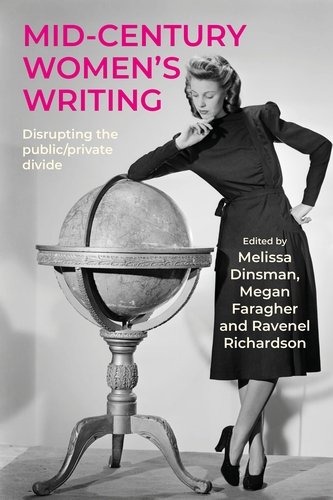
The traditional narrative of the mid-century (1930s-60s) is that of a wave of expansion and constriction, with the swelling of economic and political freedoms for women in the 1930s, the cresting of women in the public sphere during the Second World War, and the resulting break as employment and political opportunities for women dwindled in the 1950s when men returned home from the front. But as the burgeoning field of interwar and mid-century women's writing has demonstrated, this narrative is in desperate need of re-examination. Mid-century women's writing: Disrupting the public/private divide aims to revivify studies of female writers, journalists, broadcasters, and public intellectuals living or working in Britain, or under British rule, during the mid-century while also complicating extant narratives about the divisions between domesticity and politics.
-
Megan Faragher, Melissa Dinsman, and Ravanel Richardson, “Introduction: politicizing the domestic and domesticizing politics” in Mid-Century Women’s Writing: Disrupting the Public/Private Divide. Manchester University Press, 2024.
Megan Faragher, “H.G. Wells and Sociological Method” in The Oxford Handbook of H.G. Wells, Eds. Duncan Bell and Sarah Cole, Oxford University Press, forthcoming.
Megan Faragher, “Orwell and Kindness” in The Oxford Handbook of George Orwell. Ed. Nathan Waddell. Oxford University Press, forthcoming.Megan Faragher, “Propaganda, Elegy and the Everyday in Britain in Pictures” in British Writing, Propaganda, and Cultural Diplomacy in the Second World War and Beyond Eds. Beatriz Lopez, James Smith, and Guy Woodward. Bloomsbury Academic, 2024.
Megan Faragher, “Camp Camouflage: The Art of Espionage in Mr. Norris Changes Trains” in Sexuality and Gender in Fictions of Espionage: Spying Undercover(s). Ed. Ann Rea. Bloomsbury Academic, 2024.
Megan Faragher, “Fire or Blood?: Aestheticizing Resistance in Naomi Mitchison’s Narratives of Slavery” in Naomi Mitchison: A Writer in Time. Ed. James Purdon. Edinburgh University Press,2023.
Megan Faragher, “Big Data and Universal Design in The Home Market” in Humans at Work in the Digital Age: Forms of Digital Textual Labor. Eds. Shawna Ross and Andrew Pilsch. Routledge, December 2019.
Megan Faragher, “Celetoids and the City: Tabloidization of the Working Class in White Teeth and Lionel Asbo: State of England.” in Twenty-First Century British Fiction and the City. Ed. Magali Cornier Michael. Palgrave, July 2018.
-
Megan Faragher, “The Form of the Queer Travel Narrative in Kate O’Brien’s Farewell Spain (1937),” Special Issue: “Struggle & Hustle: Trans and Queer Nonfiction Prose,” Prose Studies: History, Theory, Criticism, 26 Jan. 2023. https://doi.org/10.1080/01440357.2022.2142395 (R).
Megan Faragher, “The Blitz(ed) Body: Bodily Autonomy and Institutional Reform in Susan Ertz and Virginia Woolf,” Feminist Modernist Studies, March 2022. https://doi.org/10.1080/24692921.2022.2047568 (R)
Megan Faragher, “Susan Ertz’s Sisyphean Women” Lost Modernists. vol. 1, no. 1, 2021. https://lostmodernists.com/susan-ertzs-sisyphean-women (R)
Megan Faragher, “Nazi Zombies! The Undead in Wartime and the Iconography of Mass Persuasion,” Revenant: Critical and Creative Studies of the Supernatural, 2021. http://www.revenantjournal.com/contents/nazi-zombies-the-undead-in-wartime-and-the-iconography-of-mass-persuasion-2/(R)
Megan Faragher and Caroline Krzakowski, “Modernist Institutions.” Modernism/modernity Print Plus Platform, November 2020. https://modernismmodernity.org/forums/modernist-institutions (R)
Megan Faragher “The Fourth ‘R’ is Rooted Belief’: Rex Warner and the Politics of Revisionist Classicism.” Literature & History, 28(2), 2019: 214-130. https://doi.org/10.1177/0306197319870377 (R)
Megan Faragher, “Snoop-Women with Notebooks: Naomi Mitchison, Mass Observation, and the Gender of Domestic Intelligence” The Space Between Journal. vol. 12, 2017. https://scalar.usc.edu/works/the-space-between-literature-and-culture-1914-1945/vol13_2017_faragher (R)
Megan Faragher, “The Form of Modernist Propaganda in Elizabeth Bowen’s The Heat of the Day.” Special Issue: “Elizabeth Bowen and Textual Modernity.” Textual Practice. 27(1), 2013: 49-68. https://doi.org/10.1080/0950236X.2013.752218. (R)
-
“Visualizing Institutions in Britain in Pictures.” The Modernist Studies Association Conference, November 2023.
“From Outsiders to Silicon Valley: A Cultural History of the Self-Actualized Workplace from Abraham Maslow to Aldous Huxley,” The Space Between Society Conference, Canyon, TX, June 2023.
“Experiments in Reproductive Rights: Naomi Mitchison’s Critical Labor Utopias.” The Space Between Society Conference, Cleveland, June 2022.“Opaque Propaganda and the Everyday in Britain in Pictures.” The Writer as Psychological Warrior Conference. Online via Durham University, UK. July 2021.
“Fire or Blood?: Aestheticizing Resistance in Naomi Mitchison’s Narratives of Slavery.” The Space Between Society Conference, Online, June 2021.
“Observing Wartime Women: The Gender of Sociology in the Work of Celia Fremlin.” Modernist Studies Association Conference, Toronto, October 2019.“The Psychographic Turn and Literary Modernism.” Modernist Studies Association Conference, Toronto, October 2019.
“Nazi Zombies!: The Undead in Wartime and the Iconography of Mass Persuasion.” The Space Between Society Conference, South Dakota State University, June 2019.
“Ministries and Moles: Literary Information Networks at the Ministry of Information.” [poster presentation]. Research Symposium, WSU – Lake Campus, April 2019.
“The Scale of Public Opinion: Utopianism and Polling in Olaf Stapledon and H.G. Wells.” Modernist Studies Association Conference, Columbus, November 2018.
“‘Pride in the British Achievement’: Propaganda and Minutiae in Britain in Pictures.” The Space Between Society Conference, University of Northern Colorado, June 2018.
“‘Pride in the British Achievement’: Britain in Pictures and the Quantification of Propaganda” [poster presentation]. Research Symposium, WSU- Lake Campus, April 2018.
“Camp Fascism: Isherwood’s Arthur Norris and the Aestheticization of Politics.” Modern Language Association Conference, New York City, January 2018.
“Wells’ The Shape of Things to Come: Social Psychology and Polling in the Future Tense.” The Space Between Society Conference, University of Mississippi, May 2017.
“Cooper’s Snoopers: Women and the Cultural History of Political Polling.”[poster presentation] Research Symposium, WSU- Lake Campus, April 2017
.“Data of One’s Own: The Gendering of Domestic Intelligence.” Modernist Studies Association Conference, Pasadena, November 2016.
-
Interview with Dennis Bova. "Let's Roll," Wright State Newsroom, 2024.
Interview with D.J. Taylor. George Orwell Studies, 2024.
-
Review. Modernism in Irish Women’s Contemporary Writing by Paige Reynolds, in Contemporary Literature, vol. 64, 3, 2024.
Review. George Orwell: The Ethics of Equality, in George Orwell Studies, 2024.
Review: Automatic: Literary Modernism and the Politics of Reflex by Timothy Wientzen, in The Space Between Journal. Vol .28, 2023, https://scalar.usc.edu/works/the-space-between-literature-and-culture-1914-1945/vol18_2022_wietzen_review_faragher.
Review. The Politics of 1930s British Literature: Education, Class, Gender by Natasha Periyan, in George Orwell Studies. vol. 3, no. 2. 2019.cription